Thursday, 5 November 2015

Final Project Proposal Pro Forma

Working title: Nightmare

Précis

In this body of work, I want to show what it is like to have sleep paralysis in the visual representation.

Rationale

Sleep is an action that every person does without any exception. You cannot choose how to sleep or what to dream, it is something that cannot be controlled by consciousness. There are many sleep disorders that can occur, but I am particularly interested in sleep paralysis.

Sleep paralysis is common, but under-research phenomenon. Many people experienced it at least once in their life. There are many legends and stories about sleep paralysis. People used to say that witches and demons are trying to steal their souls or more recent stories say that they have been abducted by aliens. However according to recent studies it has nothing to do with demons or aliens. It is a normal thing that may happen to everyone, but due to the fact that I have experienced it myself I cannot deny that it is one of the scariest things that can occur.

Sleep paralysis is a transient period of awakening from sleep during which the subject is unable to move or speak. You can feel the surroundings, people talking but cannot do anything. Some people even have hallucinations, which feel extremely realistic. Sleep paralysis isn’t dangerous, but inability to move can be very frightening. 

This project represents the feelings that people have during sleep paralysis. It starts with the fear of something unknown coming, something that lives in your own head, but still is able to scare you. It fallows by realisation that your body is paralysed and it won’t move even how hard you try to do it. Everything that happens during sleep paralysis is just in your own head. Things that you see can only scare you and no matter how hard you try to scream and shout for help nobody can hear you. Your voice is silenced and you are left on your own to fight it.

Aims & Objectives

Due to the fact that sleep paralysis is under-researched phenomenon I want to show to audience what it is, to introduce it to people who have never experienced it. It is also aimed at individuals, who have experienced that, so they can easily pick up on symbolism and relate to it.

It is a project, which can be displayed in the gallery.

Overview

For this project I needed a model, studio and medium format camera.

Summary

I believe that this project was successful, even though I just had 6 weeks to start and to finish it. I enjoyed working on this project, my chosen topic is something that I am interested in and have my own experience. My final images are very close to the owns I saw in my head.

Things that I would do differently if I needed to take this project again: firstly, I thing that more test shoots would have helped to make this project better. Secondly, for my final images I chose a safe environment. In studio it was easier to control the lights and surroundings. So I would try do it in the location.  


Overall, I consider that I did the best that I could with what I had in this space of time.

Gallery

Firstly, I created on Photoshop how I imagine my images would look in the gallery:


Using Photoshop I tried to create the impression of lightboxes.

I also created a virtual gallery on the internet, however I couldn't put my images in the lighboxes because there is no such option.


Wednesday, 4 November 2015

Final images


Choosing final images

In order to decide which four out of five images I want to use as my final ones I needed to put them together and see how they look.

These are different variations of display:

In this one the shadow shot stand out because it is brighter than all other images. So we decided to try using book shot instead.

However it also stand out, because it is the only image in which a girl is lying on the floor. To change that I rotated the image.

Even though tutor and other class mates stated that it looks better, personally for me it looks like model is growing books from her belly. Therefore, I decided not to use this image at all. I put the shadow image back again, just this time on the other side.

This way the shadow shot does not stand out that much, because the shadow closes the composition. Moreover I rotated the rope image horizontally, because that way she is looking in to composition and not into outside. Finally, I will make the background in the shadow shot a touch darker.


Image retouching

Some of the images was easier to retouch, I only changed colours, contrast, brightness etc. It took me more time to do the shot with the shadow.

First of all, I chose the shot because I liked the face expression, however her pose made it look like she has got a big belly and it draws the attention. So I decided to make it look smaller, I used liquify tool to make her sides look thiner and clone stamp tool to change the way shadow falls on her nightwear. 


Moreover, for this shot I needed to change the shape of shadow. For that I simply used liquify tool. I put freeze mask on my model, so I would not change her by accident.


Secondly, for my chair shot I wanted to add lines to make it look more similar to Francis Bacon painting. I used simple brush tool, however it didn't give the effect I was hoping for, so for my final image I decided to leave the image without it. 


Final shoot

For my final shoot I used medium format camera Hasselblad. I have never used it before, but I though it may be a good experience and also better quality for my images.

I used just one light for my shadow shot and two for others. On the main light I had a snood. It helped to create darker background and gave a nice light on my model. The second light I used as a catch light, to separate model from the background.

In order to get a shadow for the first image I needed to use white backdrop. For my all other shots black one worked better.

These are two different lighting set ups that I used for my photoshoot:


These are contact sheets from my final shoot:


I believe that my final shoot was successful even though I just had less than 2 hours to do 5 different set ups. I think the fact that I knew exactly what lighting I want to use and I had sketches how I want to set up helped me to do it quicker. And also I got some help from Joe Gregory, he helped me to set up, to move the lights.

Tuesday, 3 November 2015

Preparing for my final shoot

I was lucky to find a model that was willing to come to Salford and pose for my project.

Before my shoot I made a few sketches so it would be easier and faster to do everything on the day. 

The ideas that I had for my shoot and quick sketches that I made:


1. Shadow shot. Inspired by my test shoot I wanted to create a shot with model standing emotionless and with the big distorted shadow behind her. Shadow represents the creatures that appears in sleep paralysis. Everything that people see during sleep paralysis is from their own mind. It is their own creation that is why the shadow is still similar to the models shape, but just by looking closer it is obvious that is different. 


2.  Shot with the ropes. As I was talking at the begging during sleep paralysis body can't move and it feels like you are tied up. So I want to represent the feeling when try to move, but you cannot. 


3.  Shot with the books. This shot was inspired by the Henri Fuseli painting The Nightmare, where women is sleeping on her back and strange creature is sitting on her chest. It represents the feeling that most people have during sleep paralysis when you can't breathe and the feeling like someone is sitting on the chest. However in my shot I am going to use books instead of weird creature. In my case, my sisters, her friends and many others sleep paralysis occurred before the exams, when person is stressed and does not get enough sleep. so books represent the reason why sleep paralysis happens. Moreover, the books that I am going to use are going to be about sleep, sleep disorders.


4. Cling film shot. In this shot the girl would be screaming, however she would be tied up in cling film. During sleep paralysis person cannot move or talk. I am not sure how exactly yet, but cling film would cover her face, which gives a feeling like sound can't come true even how loud model screams. 


5. Shot with the chair. This shot is inspired by Francis Bacon paint of pope. In the painting he sits in the chair and screams like he saw something that other people cannot see. Sleep paralysis is very similar to that, because everything that subject sees during it is just his own creation and the only person that can see all of the things that is happening is just him. The dreams that the subject has are super realistic and can be very frightening. So the model would be sitting tight on the chair and shout like she just saw the worst nightmare ever.


Furthermore, I got an idea how I would like to display my images in the gallery. The gallery walls would be painted black and I would use lightboxes for the images. I would hang four vertical images - two near each other and other two just below them. It would look like a window. Due to the fact that the room is black and there is light coming from the lightboxes it would give a feeling of someone looking inside through bedroom's window. Sleep paralysis usually happens at the night time and in the bedroom that is why I think that kind of display would be perfect for my project.


Idea development

After looking at all the artists, talking about ideas in class and all the research about sleep paralysis I decided to be even more symbolic in my final shots. I decided to change the location of my shoot as well. Initially I was planning to shoot it in the bedroom with the subject lying on the bed, but I decided to do it in the studio. I will have more control of light and I could create more interesting shots.

Camille Vivier, Unititled, Caroline II, 2003
In my test shoot as a model I used Joe Gregory, however according to statistics sleep paralysis is more often to happen for people under age of 25. So I decided to look for a different model as well.

My final images are going to be dark, with black background and just the model lit. I also want to use catch light to help separate subject from the background.

I would like to dress my model with white nightwear, similar to the one in Camille Vivier, Unititled, Caroline II, 2003 image. Due to the fact that I am shooting my model out of context (in the studio and not in the bedroom, where sleep paralysis actually happens) I want still to give a feeling like this is happening at night in the bedroom that is why my model is going to wear nightwear.  


Thursday, 29 October 2015

Tasks

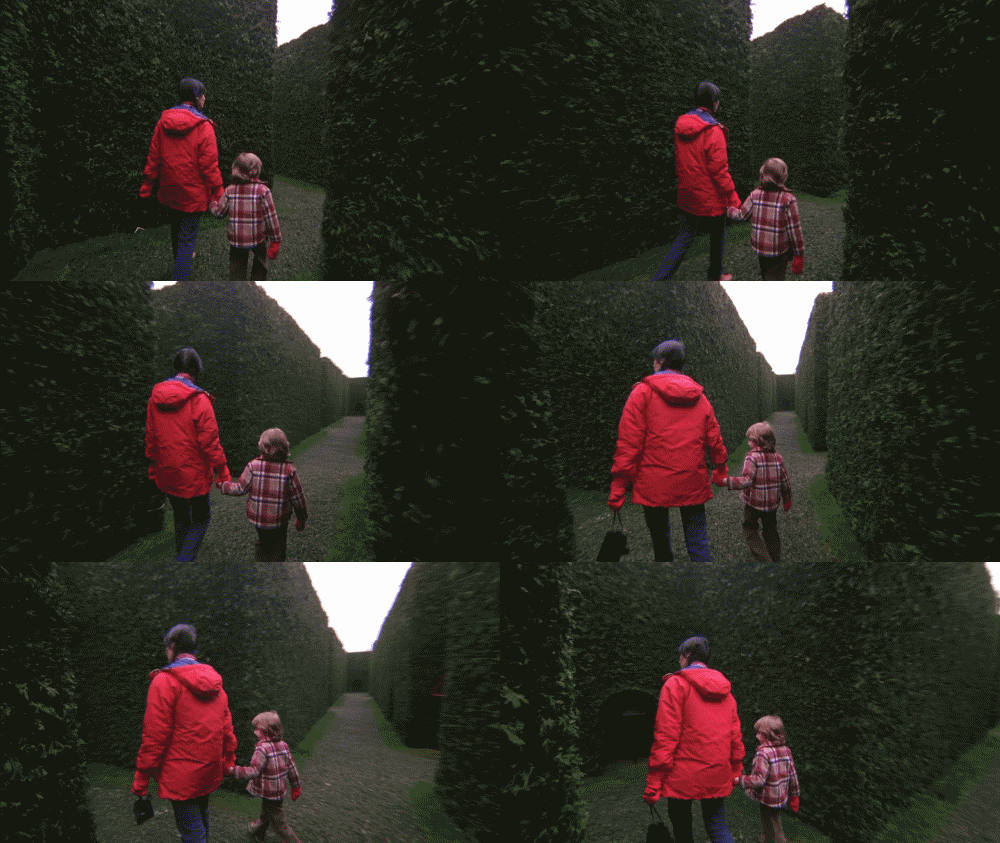
In the first two lessons after presentations we were given a small tasks. The first one that we got was to create a story. Every group got a 100 images and we needed to create at least 4 different stories using these pictures. From the first sight this task looked fun and easy, but it was harder than I thought. One of the stories that we created:


This story starts from the outside at night in the dark tunnel. Later it gets closer to the old house with an old door on which there is a lock. When you get inside the house, you can see how messy it is. While looking around you can see a table, when you get closer to it there is a scissors, stand of hair and a suicidal note. The person that lived there decided to leave this world. The last image is the light at the end of the tunnel, which symbolises death.
We could have used the same image at the end that we used at the beginning, that way that would be circular narrative.

The second task that we got was to find different cropping in one image. We were given different images and in groups we needed to mark on each image how many different ways of cropping there can be.


In this first image we found 3 more different ones. The first one is a couple sitting on the bench. The second one is 3 boys sitting on the rock, looks like two of them are older and they know everything here, whilst the younger boy, who is sitting back to other boys, looks alone and without friends. The third image is just a boy taking image of his classmates.


In this second picture we found at least 3 way of cropping. The first one would be guy sitting under the tree and another man running away from him for some reason. The second one is the same man sitting under the tree and another one holding a tree branch. It looks like an interesting scene and feels like something is just going to happen. And the last one is the man, who is holding the branch an the dog running away from him.

This task showed how different cropping can affect the story.

Filmic tropes and language

Shorthand expressions that are used when creating a film:


Distances:


XLS – extreme long shot (establishing shot). A shot in which the scale of the object shown is very small; a landscaper a cityscape, or a crowd. Such an image is often used as an establishing shot.


VLS – very long shot. Shows a lot of scenery and location, however a character is now a little bit more visible.


LS – long shot. A shot that shows a character in his or her entirety, filling most of the frame.


MLS – medium long shot. The shot that shows character from the knees upwards.  


MS – mid shot. Shows the character from the waist up.

   
MSCU – medium close up. Shows a character from the chest upwards.


CU – close up. A shot in which the head of a person, or the entirety of a small object is shown.

   
BCU – big close up. A shot, where characters top of the head and bottom of the chin are cut.
    

ECU – extreme close up shots. A shot that shows only a small portion or detail of a character’s body (eyes, ears, mouth) or a tiny object. 


POV’S – point of view:


·       1st person perspective – looking directly through somebody’s eyes


·       3rd person perspective – over the shoulder shot


Camera movements:


TILT – using a camera on a tripod, the camera moves up and down to follow the action.


PAN – A shot taken when the camera stays in one place (on a tripod, for example) but rotates or swivels horizontally.


TRACKING –  A shot taken from a moving dolly (a platform on a set of wheels) that follows the subject. 


Camera angles:


High camera angle – makes the subject look weak and vulnerable


Low camera angle – makes the subject look important and powerful


Medium camera angle – camera placed at same height as the subject (eye level)


Transitions:

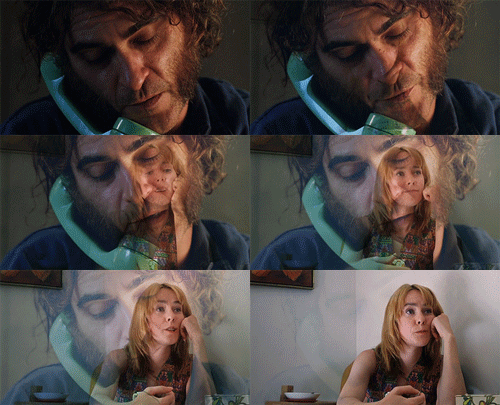
DISSOLVE - a transition between two shots, where one shot fades away and simultaneously another shot fades in.    


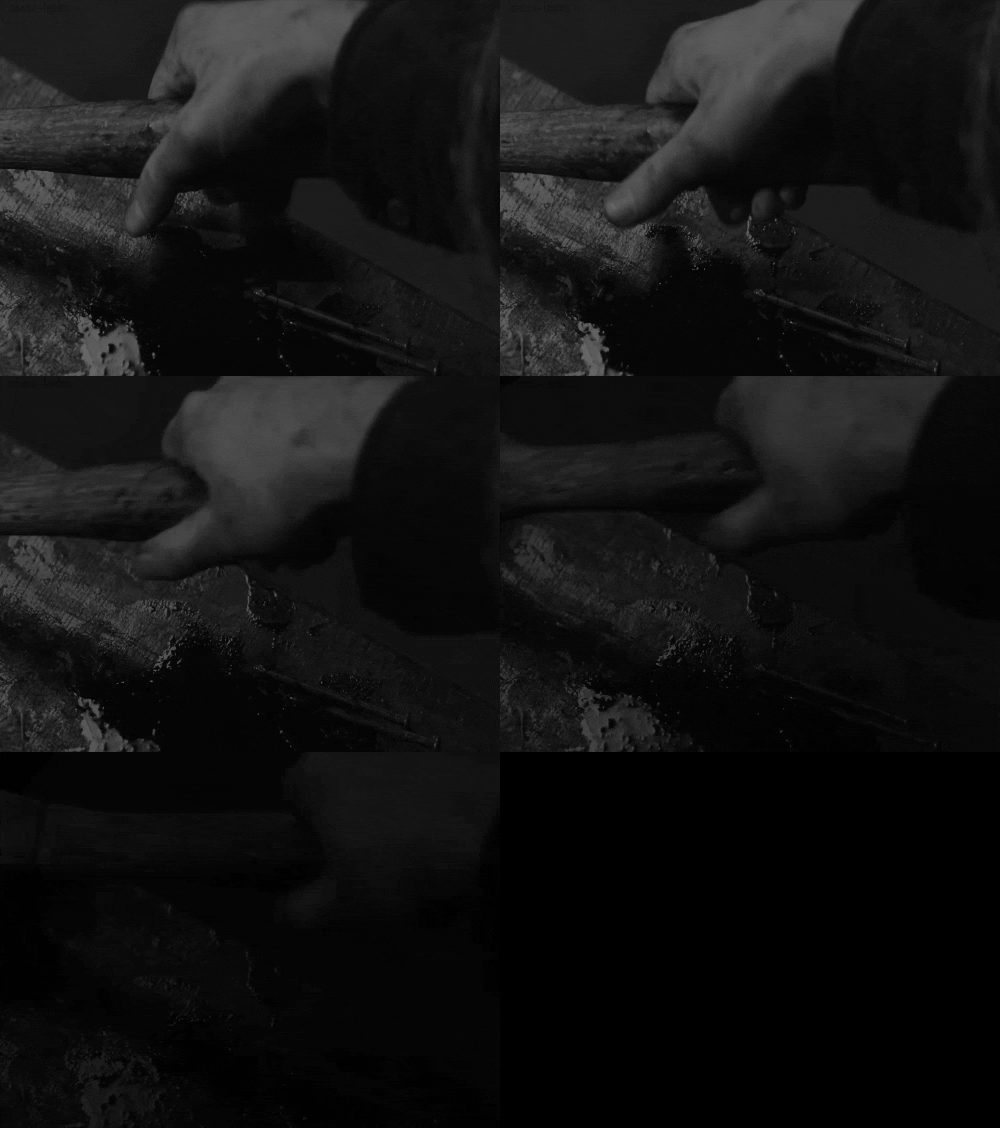
FADE – a transition from a shot to black where the image gradually becomes darker is Fade Out; or from black were the image gradually becomes brighter is a Fade In.


JUMPSCUT - A rapid, jerky transition from one frame to the next, either disrupting the flow of time or movement within a scene or making an abrupt transition from one scene to another.